


Life is a 35-Minute Flight: The Art of Emotional Hustle
I was sitting by the window, and my friend was in the first seat; the middle seat was empty. I asked the air hostess, "Can we two sit together?" The flight attendant smiled and replied, "Sir, this seat is booked; you can adjust the seat with the passenger after takeoff." We started waiting for the passenger. A few moments before the plane's doors closed, that passenger arrived. He was a large, heavyset elder; he also looked ill.
I offered him, "You take the window seat, we friends want to sit together," but he shook his head, rejected my offer, and sat down heavily right in the middle. He was bulging out from both sides. Because of him, I got pressed against the wall of the plane, while my friend hung half-out of his seat. An unpleasant odor was also coming from the fat man's body. He was breathing with his mouth wide open, and the movement of his breath was spreading the smell into the environment. Our conversation stopped. I took a rosary out of my pocket and began reciting, while my friend opened his mobile phone and sat back. That was the most difficult flight of my life.
I spent that journey in agony. When we landed in Lahore, I counted my bones and ribs and took a breath of relief. We came out of the airport. I asked my friend, "How was the journey?" He laughed and said, "Great! I have downloaded books on my mobile phone; I kept reading a book during the journey." I asked, "Were you not disturbed because of the fat man?" He laughed and said, "It happened for the first two minutes, but then I adjusted. I wedged my elbow and ribs into his stomach and quietly kept reading the book." I asked, "And were you not disgusted by his foul smell either?" He laughed and said, "In the beginning I was, but when I got lost in the book, the smell stopped coming." I looked at him in astonishment and then said, "But I kept facing distress during the entire journey; even my breathing was getting tangled. I kept praying to Allah, 'O Allah, when will this journey end?'"
He laughed and said, "I too used to get troubled in such situations, but then I found a solution to my worry. I now adjust." I stopped and began looking at him intently. He said, "We were companions of that fat man for only 35 minutes. He came, sat, the plane flew, the plane landed, and we parted ways. Who was he, where did he come from, and where did he go? We do not know. If you had adjusted to those 35 minutes, you would not have been in pain." He paused, took a long breath, and said, "Every pain of ours has an expiry time. If we estimate that time, our pain decreases. For example, when that fat man sat between us, I immediately calculated the time. I realized this is a pain of only 35 minutes. Therefore, instead of focusing on the fat man's obesity, I started reading a book. My pain ended in a few minutes. You should also estimate the duration of pain; your difficulty will also become easier."
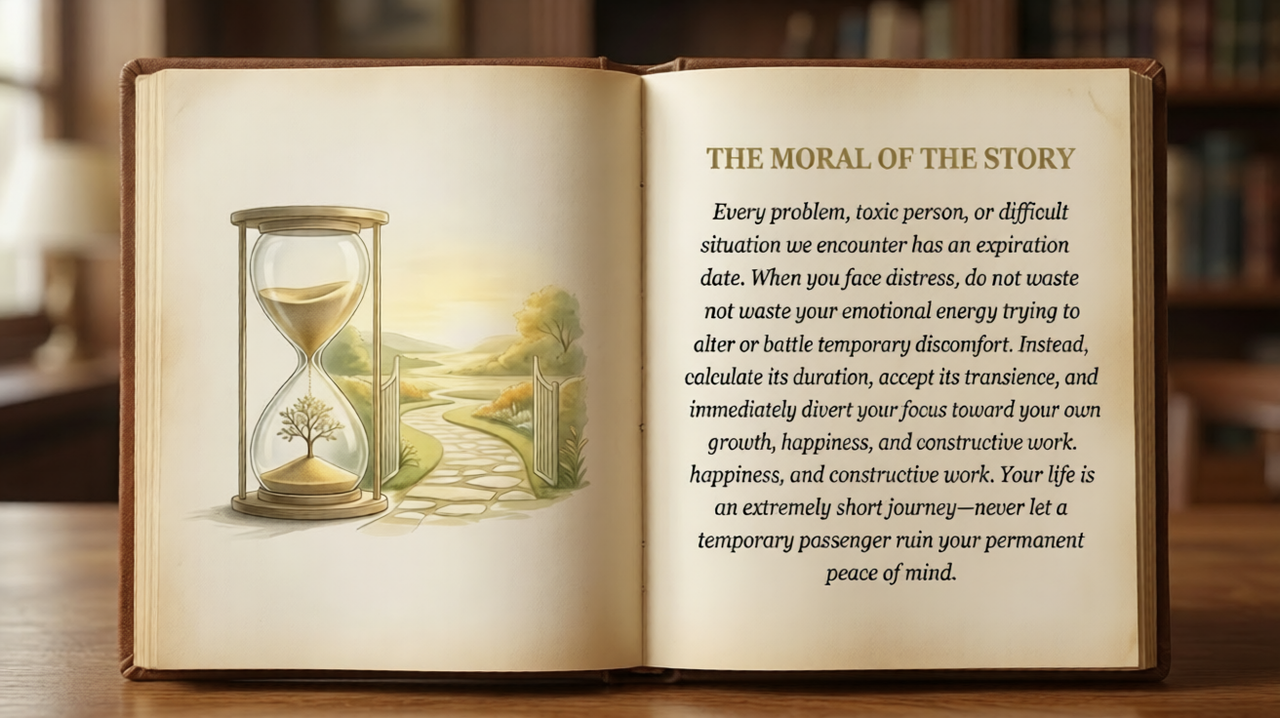
"Every pain of ours has an expiry time. If we estimate that time, our pain decreases. Calculate the duration of that distress and apply your attention to some constructive work."
I asked him, "From whom did you learn this art?" He laughed and said, "I learned this art from my father. In my childhood, a quarrelsome person moved into our neighborhood. We used to play cricket in the street, and he would uproot our wickets, snatch our ball, and he would come out into the street and shut down our game altogether. I used to be very heartbroken. One day, I complained about him to my father. My father placed his hand on my head and said, 'Son, this person is a tenant; he has come, and he will leave. Instead of fighting and entangling ourselves with him, we should wait for his departure.' I asked my father, 'Should I not even protest?' He said, 'Yes, you certainly may, but it will be your loss. This person will leave at his own time, but because of the protest, you will become ill-tempered. You won't be able to enjoy life after that. Therefore, my advice is to focus on your life; pay attention to your happiness. These and people like them will keep coming and going; they are here today and won't be here tomorrow. What is the need for you to spoil your mood?' I was a child, so I did not agree with my father's words, but our neighbor really left after two months, and thus we started playing in the street with the old spirit. We even forgot that irritable old grouch in two weeks."
During all this, I also kept going to my office peacefully, raised my children, and also kept enjoying the pleasures of life. After telling me this incident, my father often used to say, 'Whenever you fall into distress, calculate the duration of that distress and apply your attention to some constructive work; that distress will not feel like distress to you.' I took my father's words to heart; therefore, I extracted the duration of pain and diverted my attention toward some constructive work. He became silent.
This point was both new and unique for me. I asked him, "Is this your routine?" He burst into laughter and said, "Yes, whenever someone causes me pain, I say in my heart, 'This is today's issue; it will not be here tomorrow. Why should I ruin my today and tomorrow because of it?' and my pain disappears." I asked, "For example?" He said, "For example, that fat person was a pain for only 35 minutes. We only had to spend 35 minutes, and that pain was to exit from our lives. For example, if someone cheats me, I laugh at both that person and the deception and walk forward. Believe me, that deception and that person both become a forgotten tale for me after a few days. I found countless difficult bosses and terrible colleagues in my career. Looking at every difficult boss, I used to say, 'He has come, and he will leave. What is the need for me to ruin my life?' I always kept thinking about the terrible colleague as well, 'He is the shortest passenger of a short journey; he will disembark at his destination, or I will go on to my stop. What is the need for me to fight him?' Believe me, my difficult bosses left, and the terrible colleagues too, and thus my journey continued. My life passed with pleasure and is passing with pleasure." He paused, laughed, and said, "You too take this reality to heart: life is a 35-minute flight. Do not ruin your journey because of a fellow passenger. Look at the duration of the pain and divert your attention to another direction; your life will also pass well." I nodded my head in agreement.
He sat in his car, and I went to my office, but from that day until today, whenever I fall victim to any problem or any pain, I repeat in my heart, 'This is a 35-minute flight; it will end, and I will soon forget this pain. Tomorrow I won't even remember that I once sat next to such a passenger because of whom my breath was stopped and who had pasted me against the wall like a poster.' The journey of life is extremely short. If we turn this short journey into a register of complaints, this short journey will become difficult. We will disembark thousands of miles behind our destination. Therefore, let it go—let those who cause pain go, and let yourself go too. Focus only on the journey, and believe that our difficulty and our pain will end.


.png
)


